
Guides · 19 November 2025
Lighting Design for Live Music: A Kalaluha Production Guide
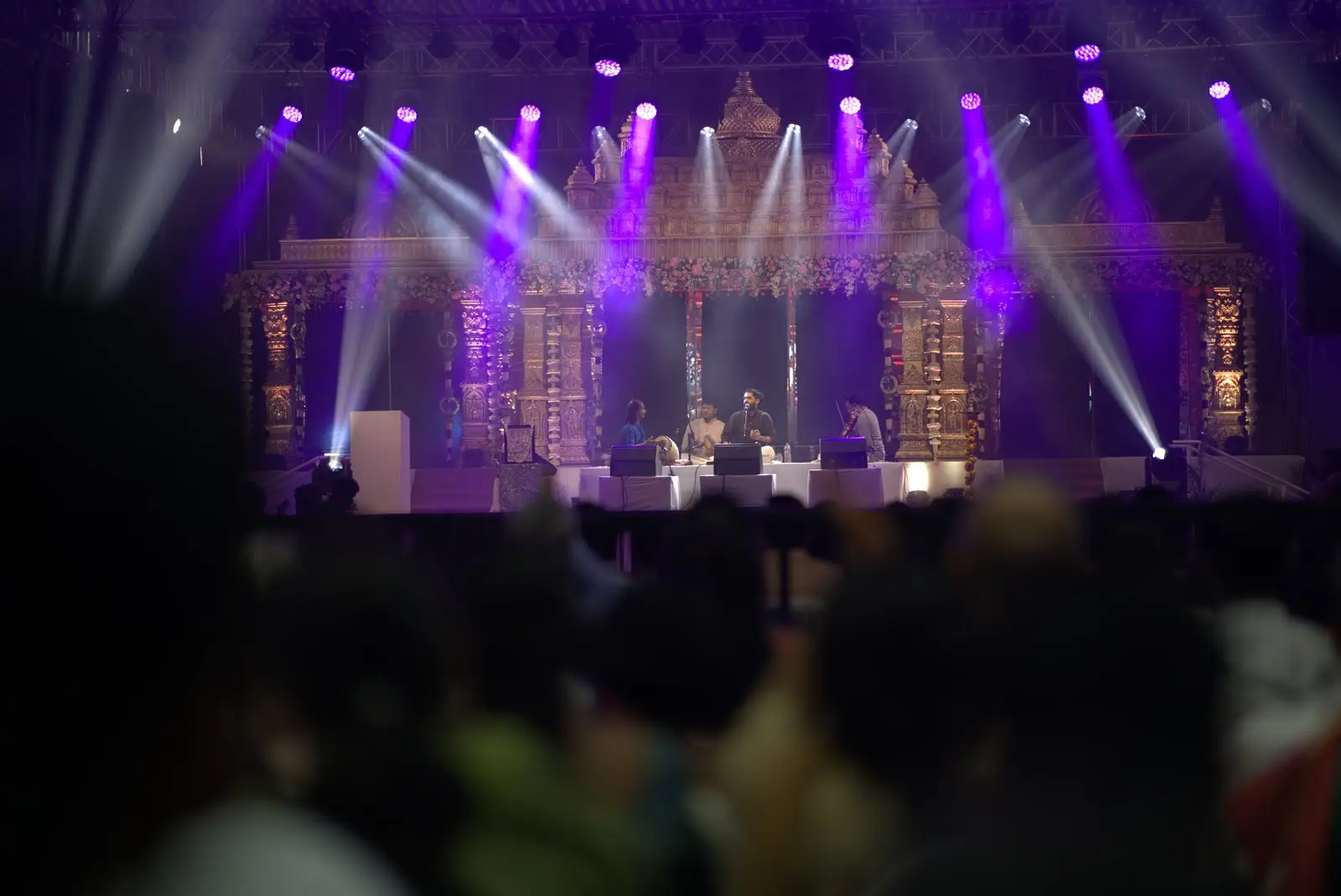
Sound is what a concert says. Light is how it feels. The same song under flat white wash and under a designed lighting state is two different experiences, and the audience cannot articulate why. They just know one night felt cinematic and the other felt like a function. Stage, sound and light production is a named pillar of Kalaluha's Live Concert Experiences service because we consider light a storytelling instrument, not a utility.
Design from the music outwards
Lighting design begins with listening. Before any fixture is specified, the designer should know the artist's repertoire, its emotional range, and its rhythm. A hip-hop night wants percussive light: hard beams, fast movement, bold saturated states that hit with the beat. A melodic evening wants light that breathes: slower transitions, warmer palettes, space for stillness. A devotional programme wants reverence: light that illuminates without performing, that serves the sanctity of the occasion rather than competing with it.
Kalaluha's portfolio spans that entire range, sometimes within a single month. The Sid Sriram Krishna Janmashtami concert at KTPO Whitefield, with thousands of devotees and a Carnatic-meets-contemporary voice at its centre, called for an entirely different visual language than a Kannada DJ night at Fandom at Gilly's Redefined. Neither language is superior. Fluency in both is the craft.
The rig is a budget of attention
Every fixture in a rig should answer the question: what job does this do? Broadly, the jobs divide into a few families. Key light makes the artist visible and cameras happy. Stage washes paint the performance area with colour and mood. Beams and effects give the big moments their scale. Audience light, used sparingly, turns the crowd into part of the picture, which matters enormously at singalong peaks.
The most common mistake in Indian live events is buying quantity instead of intention: rigs stacked with fixtures that all fire at once, all night, until nothing means anything. Restraint is what makes impact possible. If everything is a peak, nothing is. The designer's real skill is deciding what the light does not do for most of the evening, so that when it finally does everything, the room erupts.
Venue realities shape the rig too. An open field like NICE Grounds gives throw distances and rigging challenges a ballroom never will, while a premium indoor setting like The Leela Palace Bengaluru, where we staged Hip Hop Kannadigaru with holographic visual concepts inspired by legendary Kannada cinema, demands light that integrates with scenic and visual elements rather than overpowering them.
Cues are choreography
A lighting design only becomes a show through cueing: the moment-by-moment score of what changes and when. Great cueing is built in rehearsal and refined at soundcheck, with the operator learning the music's landmarks: the drop, the key change, the final chorus. On multi-artist productions the cueing challenge multiplies, because each performer deserves their own visual identity while the night holds one coherent look.
The show caller and the lighting operator must share one heartbeat. A cue that lands a half-second late is invisible on paper and unmistakable in the room. This is why we treat rehearsal time for transitions as non-negotiable: light is timing, and timing cannot be improvised.
Light is the memory the audience takes home
Ask anyone about the best concert of their life and they will describe images: the stage in gold, the beams over the crowd, the artist in silhouette. Lighting is how a production writes those images in advance. See how visual language shifts across formats in our Hip Hop Kannadigaru production and the Sid Sriram Janmashtami concert, and explore where light sits in the full stack at our services.
Keep reading
Every unforgettable night begins with an empty stage.
Start the build→