
Events · 14 August 2025
Producing Janmashtami at KTPO: Kalaluha's ISKCON Stagecraft
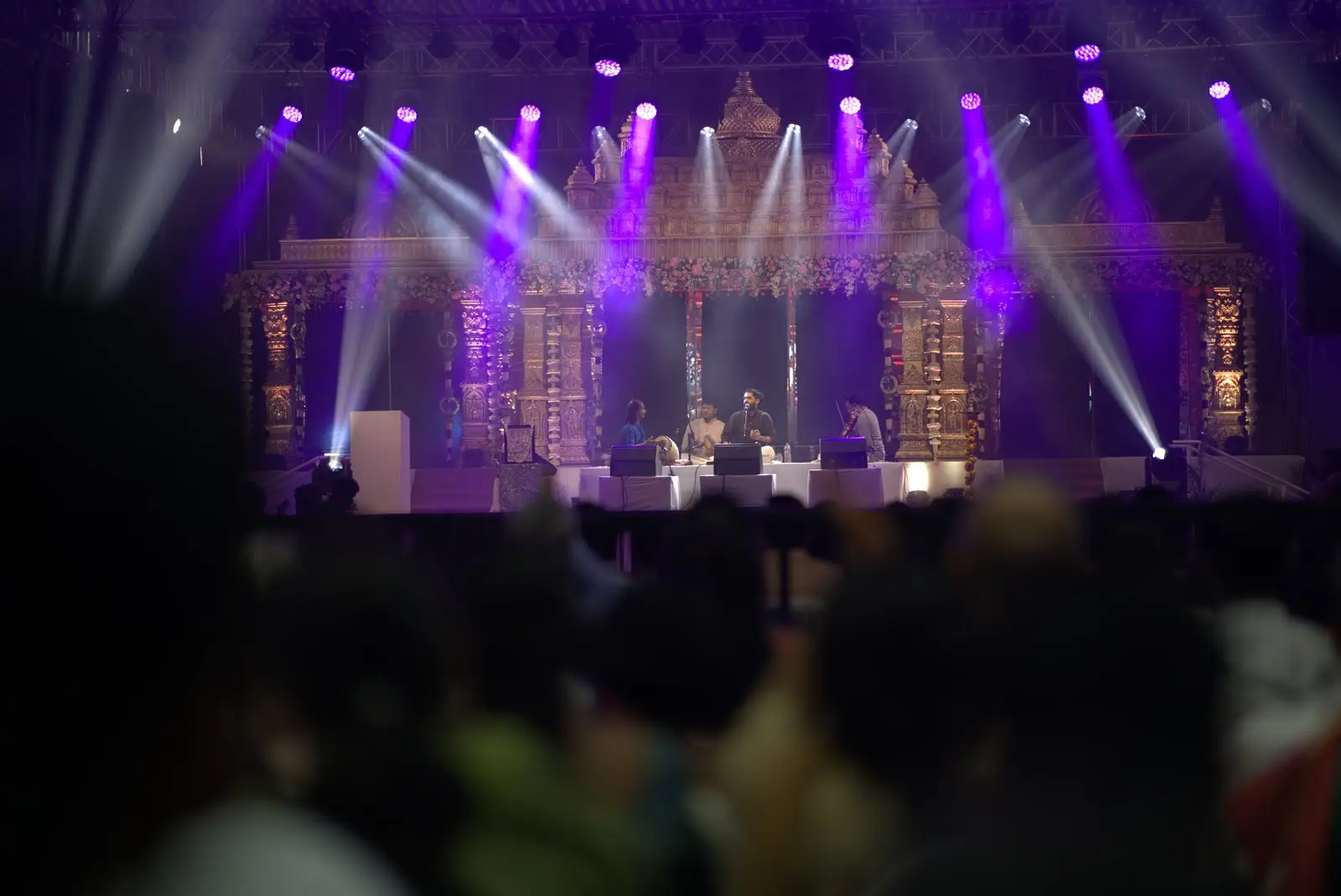
Most stages are designed for performers. A Janmashtami stage is designed for a deity, and everything else arranges itself around that fact. Producing Sri Krishna Janmashtami with ISKCON at KTPO Whitefield across the 2024 and 2025 editions, with Jana Small Finance Bank as title sponsor, asked Kalaluha to solve a design problem most concert producers never face: how do you build a production where the most important sightline in the venue is not to a singer, but to the abhishekam and the midnight arati?
Two focal points, one design
The programme moved between performance and ritual all night: Vedic chants, cultural performances, artist sets, then abhishekam and the arati at midnight. The staging had to serve both modes without awkward resets. That meant a design where the performance area and the ritual focus coexisted, with lighting states that could shift the room's attention from one to the other in seconds. Screens did serious work here. In a hall serving thousands of devotees, LED relays of the abhishekam and arati are not a luxury: they are how a person at the back participates in darshan at all. Darshan flow, listed explicitly within our faith and cultural experiences practice, begins as a screen and sightline problem long before it becomes a queue problem.
Sound for chant, raga and congregation
The audio brief spanned three very different sources. Vedic chants need natural, unforced reinforcement where clarity of syllable matters more than volume. The classical repertoire, carried across editions by artists like Siddhartha Belmannu of the Kirana and Gwalior gharanas, demands the dynamic subtlety of a concert hall mix. And congregational bhajan singing, the territory of Maanya Arora and Sooryagayathri, inverts the usual logic entirely: the room becomes the instrument, and the system must support thousands of voices singing along rather than override them. Tuning one rig in one hall to do all three across a single night is some of the most demanding audio work we do.
Light that knows when to disappear
Concert lighting seeks attention. Ritual lighting must know when to surrender it. The looks built for the cultural and musical segments used colour and movement freely, but as midnight approached, the design deliberately narrowed: warmer, stiller, focused on the arati itself, so that the lamps in hands and the deity became the brightest truth in the room. Restraint of this kind has to be programmed as carefully as any spectacle. The decor language throughout stayed rooted in the iconography of the festival, executed at convention-centre scale without sliding into theme-park excess.
Design under a deadline that cannot move
Every production has a schedule. Janmashtami has a fixed cosmic one: the arati happens at midnight, full stop. Every technical decision, from changeover plans to cue stacking, was made with that immovable anchor in mind. Two editions in, the design playbook for this celebration is now a refined, repeatable craft, which is exactly what an institutional partner like ISKCON needs from a production house.
Explore both editions on the ISKCON productions page, see how the same venue carried a different devotional register at the Sid Sriram Janmashtami concert, and find our full faith and cultural practice under services.
Keep reading
Every unforgettable night begins with an empty stage.
Start the build→