
Guides · 4 October 2025
Stage Design and LED Walls Explained, by Kalaluha's Production Team
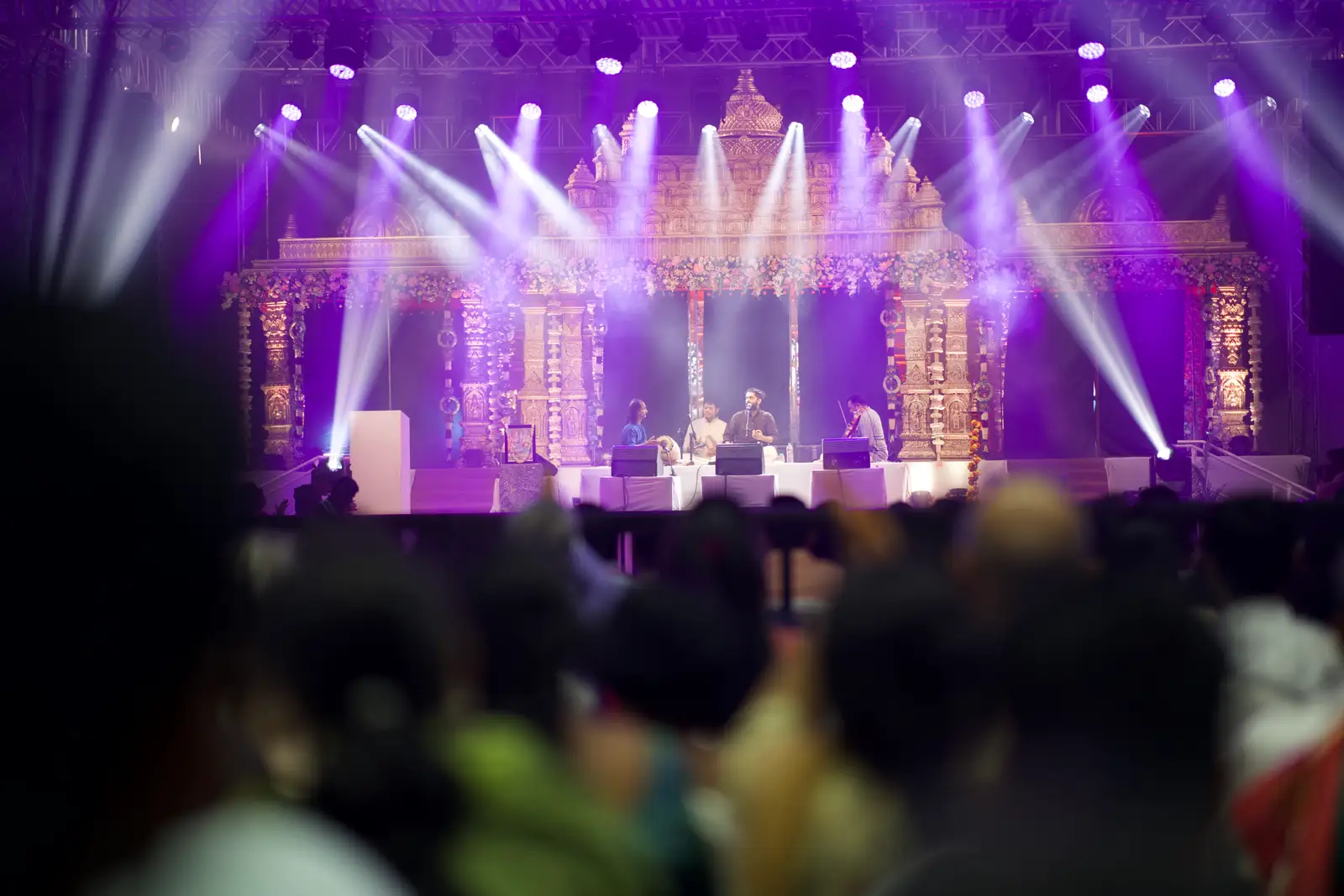
The stage is the only part of your event every single attendee looks at all night. Sound surrounds people, lights wash over them, but their eyes are pinned to one built object. That is why, at Kalaluha, stage and set engineering sits at the centre of our Large Format Productions practice, and why every design decision begins with a question that has nothing to do with aesthetics: what will the person in the last row actually see?
Sight lines decide the design
Before anyone sketches a backdrop, we stand where the worst ticket stands. At an open ground like NICE Grounds, where we produced Hiphop Tamizha's Home Edition, the last row can be a long way from the stage, so height, LED scale and elevated performance moments carry the show to the back. At The Leela Palace Bengaluru, where we staged Hip Hop Kannadigaru with its Retro to Metro theme, the room is intimate and the design language shifts entirely: there we built holographic visual concepts inspired by legendary Kannada cinema, an idea that would dissolve in an open field but felt startling in a controlled indoor space. Same company, same year, opposite designs, because the venue wrote the brief.
What an LED wall actually is
An LED wall is not a big television. It is a modular grid of cabinets, and the three decisions that matter are resolution, brightness and content. Resolution, the pixel pitch, decides how close the audience can stand before the image breaks into dots. Brightness decides whether the screen survives daylight; an outdoor evening show that starts before sunset needs panels that fight the sun for an hour. Content is where most organisers underspend. A wall is only as good as what plays on it, and content must be built to the wall's exact dimensions, not stretched from a phone-shaped file. Our design lead Megharaj S N holds every frame to what he calls the forty-feet-wide standard: if artwork cannot survive being blown up to forty feet, it does not go on our screens. You can see that discipline across his portfolio wall.
The stage serves the artist, not the renders
A design that looks spectacular in a deck can fail a performer. A Carnatic-meets-contemporary vocalist like Sid Sriram, whom we staged at KTPO Whitefield for Krishna Janmashtami, needs the audience's focus on voice and mood, so the visual environment supports rather than competes. A film-music tribute like Crazy Brahma, with five major playback voices sharing one evening, needs a stage that can reset its identity between segments. And a devotional production like Nandagovindam Signature Edition, with orchestral arrangements under music director Sharreth, treats the stage as a sacred setting first and a spectacle second. The genre sets the grammar; the engineering follows.
Build in the boring safety margin
Stage design ends in structural reality: wind loading on outdoor structures, power redundancy for the walls, crew access, and clearances signed before load-in. This is unglamorous and completely non-negotiable. Our services stack pairs LED walls, screens and broadcast with power, crew and site logistics for a reason: a beautiful wall with an unreliable power plan is a countdown to a blackout. The producer's rule is simple: nothing goes vertical until the paperwork and the physics agree.
Good stage design is invisible in the best way. The audience remembers the artist, the moment, the roar, never the trussing that made it possible. That invisibility is the craft. If you are planning a build and want to see how these principles look across formats, from palace ballrooms to open grounds, explore our production services and walk through the shows on our work archive.
Keep reading
Every unforgettable night begins with an empty stage.
Start the build→